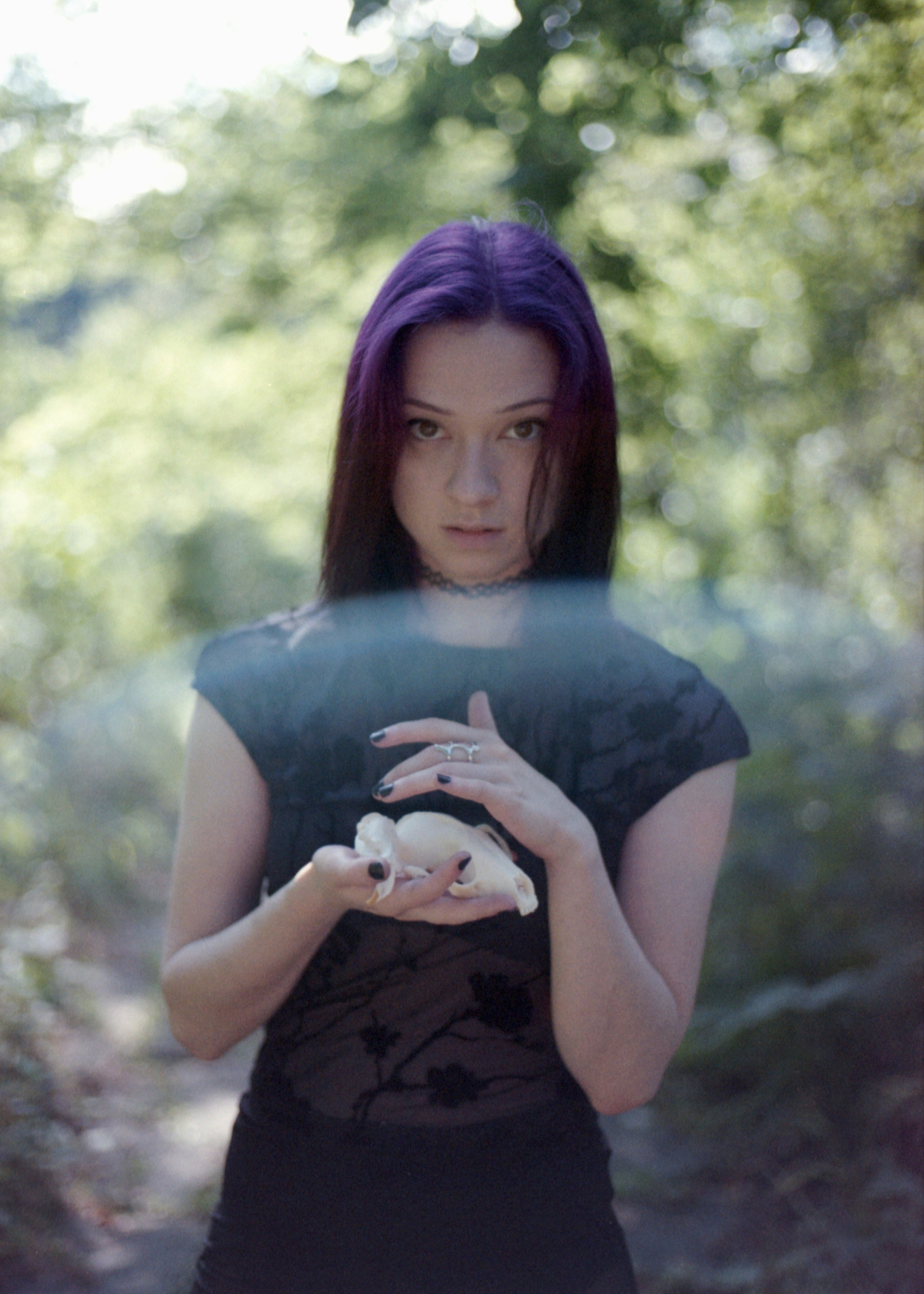
Persephone
Amongst a field of flowers, a young Persephone drifts.
Daughter of Demeter, goddess of the harvest
And of Zeus, ruler of the gods.
Seeing the maiden from below the grave, a desire in Hades grows.
He stretches from his deathly throne with cold fingers,
His touch poisoning the roots of the blooming, golden-white narcissus.
As Persephone plucks the flower from the soil,
The ground opens up and he seizes her on the back of his chariot,
Carrying her down to the underworld as his queen.
Plants wither and frost covers the land as Demeter neglects the earth.
As people begin to fall, they call to Zeus,
Forcing Hades to return their daughter to the living.
Granting the goddess freedom, he presents her with a crimson pomegranate.
As its seeds pass her lips, she is forever bound,
For six months of each year, dwelling amongst the dead.


-
Like a few other series, this one came out of thinking about myth and fairytale as a starting point. Persephone felt like the right story to work with because it's already built around duality — light and shadow, mortal world and underworld, spring and the six months she spends below. I wasn't interested in illustrating the myth beat by beat so much as focusing on the transitional moments themselves, the thresholds where she's neither fully one thing nor the other.
Pomegranates show up throughout in different states — whole, split open, seeds exposed — functioning as both a literal prop tied to the myth and a stand-in for the binding choice at the center of the story. The metal crowns were shot with deliberate lens flare, so they'd catch light almost like a halo, tying the mortal-world imagery back to something more otherworldly even in the brighter frames.
-
Shot on a combination of Kodak Gold 200 and Polaroid 600, including some black and white Polaroid exposures shot in cold weather, which affects how the chemistry develops and added an extra layer of unpredictability to those specific frames. Gold 200 handled the warmer, more composed 35mm shots — its rich shadow detail and golden highlight quality worked well for anything meant to represent the mortal, aboveground side of the story.
Polaroid brought the more immediate, intimate moments, with its own unpredictable color shifts (or in some cases, black and white tonal shifts from shooting cold) adding a rougher, less composed quality that contrasted with the more deliberate 35mm frames. That contrast between the two formats — controlled versus immediate — mirrored the duality I was trying to get at conceptually: Gold 200 standing in for the mortal realm's warmth, Polaroid's instability echoing the underworld's uncertainty.
-
Model: Aleah Gani
Hair: Arpita B Artistry
Makeup: Francely Makeup
Stylist: Krystell Barraza -
Kaiouti Magazine
Colorwall